The Office of the Controller of Examinations (CoE) at K.S. Rangasamy College of Arts and Science (Autonomous) plays a pivotal role in ensuring a fair, transparent, and efficient examination system. Established with the grant of autonomous status in 2009–2010, the fully automated CoE oversees the planning, conduct, evaluation, and publication of examinations with the highest standards of integrity, confidentiality, and accuracy. Committed to academic excellence, the CoE supports outcome-based education through technology-driven processes, ensuring timely and reliable assessment services for all stakeholders.
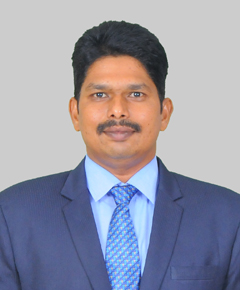
Dr. M. Venkatesh, Controller of Examinations, has over 13 years of experience in teaching, research, and academic administration. He holds an M.Sc. and Ph.D. in Physics, with specialization in Condensed Matter Physics, Nonlinear Dynamics, and Materials Science.
As Controller of Examinations, he is responsible for ensuring the smooth conduct of examinations, implementing technology-driven assessment systems, and maintaining transparency, confidentiality, and academic integrity in all examination-related processes.
His leadership has significantly contributed to the modernization of the institution's examination system. He has published 32 research papers in reputed national and international journals and has three patents to his credit. He has received seven awards and recognitions, including the Best Researcher Award – 2019 from the Nehru Group of Institutions.
Through his commitment to quality assurance, innovation, and student-centric practices, he continues to play a vital role in advancing academic excellence and institutional growth.
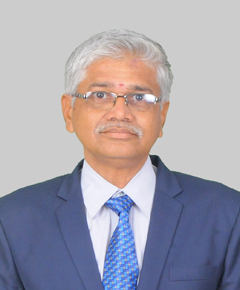
Dr. J. Ramesh, Head of the Department of Computer Applications and Deputy Controller of Examinations, has more than 22 years of experience in teaching, research, and academic administration. He holds M.C.A., M.Phil., and Ph.D. degrees in Computer Science, with specialization in Image Processing.
He plays a pivotal role in the effective administration of examinations by implementing technology-driven systems that ensure accuracy, confidentiality, transparency, and academic integrity throughout the examination process.
Dr. Ramesh has published 15 research papers in reputed national and international journals. His valuable contributions have strengthened the institution's examination system while promoting quality assurance, innovation, and academic excellence.
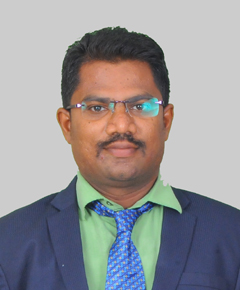
Dr. S. Karthikeyan is an Assistant Professor in the Department of Electronics and Communication and serves as the Assistant Controller of Examinations. His areas of specialization include VHDL Programming, Embedded Systems, Digital Electronics, Nanomaterials, and Biomedical Instrumentation.
With a strong academic background and extensive research expertise, he has contributed to the development of innovative electronic systems and nanotechnology-based applications. His work effectively bridges theoretical concepts with practical solutions, promoting scientific innovation and technological advancement.
Dedicated to excellence in teaching, research, and academic administration, he actively mentors students and contributes to interdisciplinary research while supporting efficient, transparent, and technology-enabled examination processes.
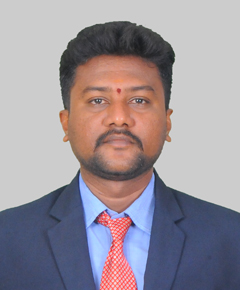
Mr. T. Dineshgopi is an Assistant Professor in the Department of Commerce (Computer Applications) and serves as the Assistant Controller of Examinations. His areas of expertise include Finance, Marketing, and Accounting Software.
A dedicated academician and a member of the Education Research and Development Association (ERDA), he has published four research articles in reputed journals.
He actively contributes to the effective administration of examinations by promoting technology-enabled systems, ensuring transparency, quality, confidentiality, and academic integrity in every stage of the examination process.
| S.No. | Name | Designation |
|---|---|---|
| 01 | Ms. P. Rajeswari | CoE MIS Incharge |
| 02 | Ms. S. Punitha | CoE MIS Incharge |
| 03 | Ms. M. Abinaya | CoE Data Entry Operator |
| 04 | Ms. P. Sangeetha | CoE Data Entry Operator |
| 05 | Mr. K. Dhanasekaran | CoE Office Attender |
| 06 | Ms. K. Elavarasi | CoE Office Attender |
The College follows a comprehensive evaluation system that combines Continuous Internal Assessment (CIA) and End Semester Examinations (ESE) for both Undergraduate and Postgraduate programmes.
The Continuous Assessment components include:
The Comprehensive Examination (End Semester Examination), comprising both Theory and Practical components, is conducted twice every academic year.
Students must secure a minimum of 75% attendance in both theory and practical courses to be eligible for the End Semester Examinations.
Eligibility for practical examinations is subject to the submission of duly certified record notebooks.
Students who fail in any course shall appear for subsequent examinations under the regulations and syllabus applicable at the time of their reappearance.
K.S. Rangasamy College of Arts and Science (Autonomous) introduced the Choice-Based Credit System (CBCS) from the academic year 2009–2010 in accordance with the guidelines of TANSCHE, UGC, NEP-2020 and Periyar University.
The CBCS framework provides students with greater academic flexibility by enabling them to choose courses across disciplines, pursue interdisciplinary learning, and enhance their employability and career prospects.
In alignment with CBCS, the institution follows the Outcome-Based Education (OBE) framework to ensure that teaching, learning and assessment are aligned with clearly defined learning outcomes.
The OBE approach focuses on what students are expected to know, understand, and demonstrate upon successful completion of their academic programmes.
The curriculum is designed with clearly defined Programme Outcomes (POs), Programme Specific Outcomes (PSOs), and Course Outcomes (COs).
Students shall earn the following minimum credits for the successful completion of their respective programmes.
The College provides a flexible academic framework that promotes interdisciplinary learning, professional competence, employability, research aptitude, and holistic student development.
Core courses that provide in-depth knowledge and competency in the chosen discipline.
Elective courses that enable students to specialize in areas of their interest.
Courses that encourage interdisciplinary learning and broaden academic perspectives.
Enhance communication, language proficiency, analytical skills, environmental awareness and values.
Develop practical, technical, employability and entrepreneurial skills required by industry.
Community engagement programmes that develop leadership, civic responsibility and social commitment.
Industry and field-based training that bridges classroom learning with professional practice.
Research-oriented learning that strengthens problem-solving, critical thinking and presentation skills.
Value-added, certificate and competency-based courses that help students acquire advanced knowledge and specialized skills.
Download the Odd and Even Semester Examination Time Tables for the respective academic years.
This section allows you to download all the necessary examination-related application forms and supporting documents. Please select and download the required file.